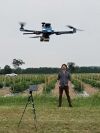
The path to plant science wasn’t a straight line for Thomas Hawkins. Before pursuing a degree in soil and crop sciences at Colorado State University, he served in the U.S. Army and worked in information technology. Today, his interests span agronomy, phenotyping, and remote sensing, but his journey began with a love of the outdoors.
“I’ve always been really into conservation and sustainability,” Hawkins said. “I loved hiking, being in nature, and even foraging.”
That curiosity evolved into a passion for science thanks to an unforgettable soil science professor whose enthusiasm transformed the way Hawkins viewed the natural world.
“The way he talked about science felt like magic,” Hawkins recalled. “I’d have to go back after class and teach myself everything because it was over my head, but once I started understanding it, I knew this was what I wanted to do.”
When Hawkins arrived at the Boyce Thompson Institute (BTI) for the Research Experience for Undergraduates (REU) program, he was stepping into unfamiliar territory. Despite his academic interests, he had very little hands-on research experience and had never spent significant time working in a laboratory.
“I was really looking forward to just being in a lab,” he said. “I’d never really had that opportunity before.”
Initially, Hawkins hoped to work on projects involving remote sensing or phenotyping, but he quickly discovered that the lab he joined was an even better fit than he had imagined.
 “I think I got placed perfectly,” he said. “I don’t know if anybody else would have enjoyed it as much as I did.”
BTI’s unique research environment also made the program especially appealing.
“The research areas here are so rare,” Hawkins said. “It really feels like this place is the center of the world.”
The transition into research wasn’t always easy. Surrounded by talented undergraduate researchers with diverse scientific backgrounds, Hawkins initially questioned whether he belonged.
“I came in feeling out of place,” he said. “Everyone seemed so knowledgeable.”
Over time, however, he realized that every scientist brings different strengths to the table.
“I found that everybody has expertise in their own area,” he said. “People even started asking me for help with computer-related things. We all work together, and we all form one big brain.”
That collaborative spirit extended beyond his fellow students. Hawkins credits his mentor, Alen, with helping him navigate the early stages of his project when the sheer volume of new information felt overwhelming.
“I finally told him I needed to see the bigger picture,” Hawkins said. Together they created a written roadmap for the project, giving Hawkins a clearer understanding of the goals and timeline. “Once I could see where everything was going, it became my project instead of just something I was working on.”
Throughout the summer, BTI’s seminars and workshops broadened Hawkins’ perspective on plant science. A seminar exploring remote sensing for plant pathogens introduced him to new applications of technology in agriculture, while a bioinformatics workshop provided practical skills he immediately applied to his own research.
“It completely changed how I worked,” Hawkins said. “I wouldn’t have been able to build what I did without it.”
Outside the lab, Hawkins found an equally rewarding experience in the REU community. Although he initially worried that being older than many of the other participants might make it difficult to connect, those concerns quickly disappeared.
“I have a core group of friends here,” he said. “My mentor Alen, my social mentor Vishwa, and everyone in the lab have been incredible.”
Those relationships, and the opportunity to work alongside scientists at BTI and Cornell, have also reshaped his future plans. Before the summer, Hawkins envisioned earning a master’s degree before entering industry. Now, he’s seriously considering pursuing a Ph.D.
“Being here changes the way you think about what’s possible,” he said.
Perhaps that’s the lesson Hawkins will carry with him most. Through conversations with faculty, mentors, and fellow researchers, he has come to appreciate that scientific careers are rarely linear.
“I’ve learned you’re never as pigeonholed as you think you are,” he said. “People move between fields all the time and make incredible discoveries.”
For Hawkins, the REU experience reinforced that the best opportunities often come from following curiosity wherever it leads.
“If you ever find yourself lacking inspiration,” he said, “go to where the inspiration is. I think humanity benefits from that.”


