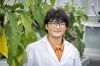
For Benicio “Benny” Sandoval, plant science is more than an academic pursuit; it’s a way to solve real-world problems.
A senior studying sustainable agriculture and food systems at East Texas A&M University, Sandoval is passionate about improving food production through plant breeding, particularly for controlled environment agriculture. Whether it’s developing crops for urban farming or creating more sustainable production systems, he is driven by research that can make a tangible difference.
“I’m most passionate about the applied research questions that solve direct problems that improve quality of life,” Sandoval said. “Whether it’s increasing access to more nutritious food in urban environments or improving our food system so that it can be more sustainable and efficient overall.”

His interest in agriculture first took root while taking elective horticulture courses at community college. Those classes opened the door to research opportunities that ultimately led him to pursue agricultural science and plant breeding.
Before arriving at the Boyce Thompson Institute (BTI) as part of the Research Experiences for Undergraduates (REU) program, Sandoval had already gained valuable research experience. At East Texas A&M, he worked in a vegetable physiology lab studying sustainable nitrogen and water-use efficiency in controlled environment agriculture. He also completed an internship with the Texas A&M AgriLife Research and Extension Center, where he worked with watermelon seed physiology and germination.
Those experiences introduced him to the world of undergraduate research and ultimately encouraged him to apply for NSF-funded REU programs like BTI’s.
At BTI, Sandoval was eager to build on that foundation by gaining experience with advanced biotechnology techniques that weren’t readily available at his home institution.
“I’ve been looking forward to getting my hands on more advanced and modern biotechnology,” he said. “That way I can feel more comfortable in a wet lab and gain experiences that aren’t necessarily available to me at my home institution.”
His summer research focuses on one of eggplant’s most destructive diseases: Verticillium wilt, a soilborne fungal disease that currently has no commercially deployable genetic resistance. Evaluating resistance has traditionally been a labor-intensive and highly subjective process, creating a bottleneck for plant breeders.
To help address that challenge, Sandoval’s project uses droplet digital PCR (ddPCR) to quantify fungal DNA inside infected eggplants. By objectively measuring how the pathogen progresses through different plant varieties over time, researchers hope to create a faster, more reliable method for identifying disease resistance.
“This research seeks to establish an objective foundation that we can build on to improve breeding efforts for resistance to this disease,” Sandoval said.
For him, the implications reach well beyond eggplant.
“Pathogens and diseases are continually evolving,” he said. “It’s critical that we keep up with these diseases and develop resistance in order to safeguard our food systems.”
Throughout the summer, Sandoval found that research involved far more than simply following established protocols. Instead, many experiments required troubleshooting, refining methods, and constantly reevaluating assumptions.
“Developing new methods comes with a lot of different trials,” he said. “Seeing what works, and how you can make it work better, is all part of advancing the research.”
Those challenges helped strengthen both his technical skills and his approach to scientific thinking.
“Being in this program has given me the opportunity to really troubleshoot and understand how to apply the scientific method rigorously,” he said.
Just as importantly, the experience taught him an essential lesson about balance.
“When you’re spending day in and day out working on a project, it can become everything you think about,” Sandoval said. “This has been a tremendous opportunity to learn how to separate yourself from your work and maintain a healthy work-life balance.”
Outside the laboratory, Sandoval found equal inspiration through BTI’s seminars and the broader REU community.
“There hasn’t been a single seminar where the speaker has not been absolutely fascinating,” he said. “You’re hearing from people who are really pushing the envelope in their fields, and being able to ask them questions has been eye-opening.”
Living alongside fellow REU students also created a unique sense of community.
“Being in a cohort of students who are all essentially in the same boat with their projects has been an incredibly unique experience,” he said.
The opportunity to explore Ithaca and regularly travel to Cornell AgriTech in Geneva also gave him a broader appreciation for New York’s research ecosystem.
“It’s been fantastic getting to see not just what Ithaca has to offer, but what the whole Cornell AgriTech system is doing,” he said.
Looking ahead, Sandoval plans to pursue graduate school, focusing on plant breeding and genetics for controlled environment agriculture. He envisions developing crop varieties optimized for hydroponic systems while tackling larger challenges such as salinity tolerance and sustainable resource use.
“This program has affirmed my decision to pursue graduate research,” he said.
Although his long-term career path is still taking shape, one thing is certain: he wants his work to improve the future of agriculture.
As he reflects on the summer, Sandoval also hopes more students will have opportunities like the BTI REU.
“I really feel like these programs are a net positive for society,” he said. “They’re giving people the tools they need to advance science, and ultimately, science advances the public good.”
*Banner image credit: Image Credit: Jason Koski/Cornell University*


