
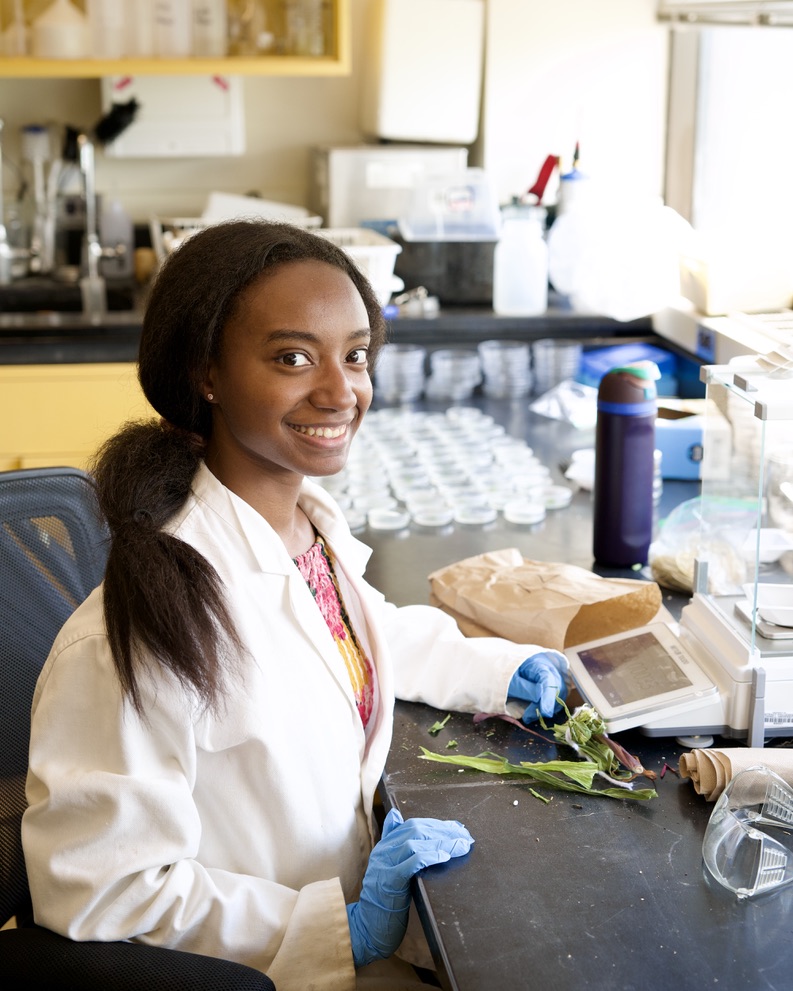
 As she enters her senior year at the University of Oregon, Environmental Science major Tetianna Smith-Drysdale has spent the summer expanding her research experience and scientific understanding in Andre Kessler’s lab at Cornell University through the REU program at the Boyce Thompson Institute (BTI). Her journey has been shaped by curiosity, determination, and a passion for the hidden world of life under our feet.
“It started off with the AP Environmental Science class that I took as a senior,” she explained. “It was the first AP class I had ever taken, and it was really difficult. But after changing the way I approached science and the way I studied, I became really passionate about it.”
That passion followed her to college, where she took initiative by emailing every professor with an ecology lab until someone responded.
“Only one of them responded,” she laughed, “but I joined her lab and eventually worked with a graduate student on plant relationships.”
Through the McNair Scholars Program, Tetianna developed her own summer research project focused on arbuscular mycorrhizal fungi, microscopic organisms that form beneficial relationships with plants.
“I presented at a couple places including my university’s annual symposium and UCLA, and I also wrote a whole manuscript that will hopefully be published.”
It was a move that launched her into the world of plant-fungi interactions and eventually led her to the REU (Research Experience for Undergraduates) program at BTI and Cornell. Through the program, Tetianna joined a chemical ecology lab studying plant responses to insect herbivory. Her summer research asks a pressing question: can mycorrhizal fungi improve crop resistance to pests and reduce the need for pesticides?
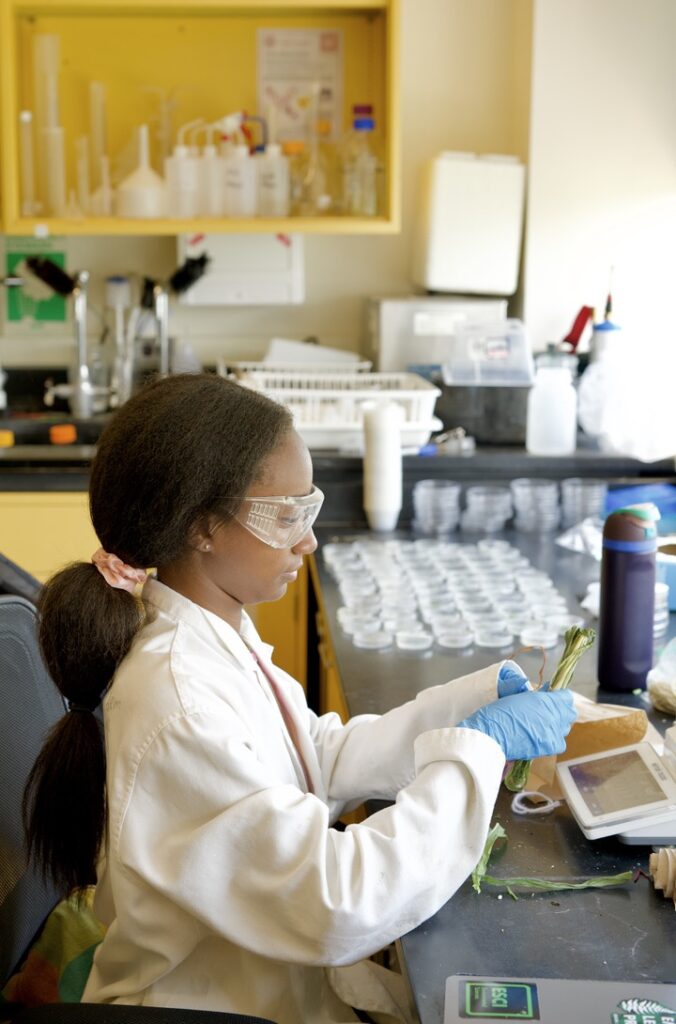 “Our research question is: what factors increase yield and herbivore resistance in diversified cropping systems?” she said. “Our hypothesis is that the intercrop Desmodium, which is a legume, will increase the beneficial below-ground interactions, those being arbuscular mycorrhizal fungi.”
While Tetianna came into the program with a solid foundation, the REU program has pushed her further as a scientist.
“For the first time, I feel like I know what I’m doing,” she said. “It’s really cool to apply the things I learned at my home institution here, and to see how other people approach the same things. It’s affirmed for me that I want to go to graduate school, because I just overall love everything about research, and I love everything about being a scientist.”
Her long-term goal is clear: to become a soil scientist leading an agroecology-focused lab at an R1 university, conducting research that supports both farmers and the environment.
“I think it’s very important to explore ways we can make our agricultural settings more sustainable,” she said. “I’m curious about how changing the soil environment will influence that.”
Outside of the lab, Tetianna has found joy in community outreach, recently participating in an event at the Ithaca Farmers Market.
“We were teaching the public: kids, elderly, farmers, etc. about the importance of this fungi in agricultural settings,” she said. “It was really cool because as I was telling people about the fungi, they were telling me their own experiences with farming and soil. It was a really beautiful exchange.”
Like any real-world scientist, Tetianna also experienced setbacks. Her team’s initial plan to test pest resistance with live larvae had to be scrapped when protective cotton wrappings damaged the plants.
“We had to pivot,” she said. “We used a mechanical induction method instead, basically rolling a tiny pizza cutter-like device on a specific leaf and applying larvae saliva to mimic real herbivory. So far, it’s working.”
Through it all, what has mattered most is the sense of collaboration and community.
“I’m working very closely with two undergrads, and we’ve fostered a friendship beyond research,” she said. “It’s just fun and exciting for me to work with people that can learn from me, but also that I can learn from.”
Reflecting on her time at BTI, Tetianna expresses nothing but gratitude.
“The friends I’ve made, my graduate mentor, the intellectual curiosity everyone has, it’s all just affirmed for me that I want to work in environments like this in the future, where people have that same curiosity and lust for learning.”
As she enters her senior year at the University of Oregon, Environmental Science major Tetianna Smith-Drysdale has spent the summer expanding her research experience and scientific understanding in Andre Kessler’s lab at Cornell University through the REU program at the Boyce Thompson Institute (BTI). Her journey has been shaped by curiosity, determination, and a passion for the hidden world of life under our feet.
“It started off with the AP Environmental Science class that I took as a senior,” she explained. “It was the first AP class I had ever taken, and it was really difficult. But after changing the way I approached science and the way I studied, I became really passionate about it.”
That passion followed her to college, where she took initiative by emailing every professor with an ecology lab until someone responded.
“Only one of them responded,” she laughed, “but I joined her lab and eventually worked with a graduate student on plant relationships.”
Through the McNair Scholars Program, Tetianna developed her own summer research project focused on arbuscular mycorrhizal fungi, microscopic organisms that form beneficial relationships with plants.
“I presented at a couple places including my university’s annual symposium and UCLA, and I also wrote a whole manuscript that will hopefully be published.”
It was a move that launched her into the world of plant-fungi interactions and eventually led her to the REU (Research Experience for Undergraduates) program at BTI and Cornell. Through the program, Tetianna joined a chemical ecology lab studying plant responses to insect herbivory. Her summer research asks a pressing question: can mycorrhizal fungi improve crop resistance to pests and reduce the need for pesticides?
“Our research question is: what factors increase yield and herbivore resistance in diversified cropping systems?” she said. “Our hypothesis is that the intercrop Desmodium, which is a legume, will increase the beneficial below-ground interactions, those being arbuscular mycorrhizal fungi.”
While Tetianna came into the program with a solid foundation, the REU program has pushed her further as a scientist.
“For the first time, I feel like I know what I’m doing,” she said. “It’s really cool to apply the things I learned at my home institution here, and to see how other people approach the same things. It’s affirmed for me that I want to go to graduate school, because I just overall love everything about research, and I love everything about being a scientist.”
Her long-term goal is clear: to become a soil scientist leading an agroecology-focused lab at an R1 university, conducting research that supports both farmers and the environment.
“I think it’s very important to explore ways we can make our agricultural settings more sustainable,” she said. “I’m curious about how changing the soil environment will influence that.”
Outside of the lab, Tetianna has found joy in community outreach, recently participating in an event at the Ithaca Farmers Market.
“We were teaching the public: kids, elderly, farmers, etc. about the importance of this fungi in agricultural settings,” she said. “It was really cool because as I was telling people about the fungi, they were telling me their own experiences with farming and soil. It was a really beautiful exchange.”
Like any real-world scientist, Tetianna also experienced setbacks. Her team’s initial plan to test pest resistance with live larvae had to be scrapped when protective cotton wrappings damaged the plants.
“We had to pivot,” she said. “We used a mechanical induction method instead, basically rolling a tiny pizza cutter-like device on a specific leaf and applying larvae saliva to mimic real herbivory. So far, it’s working.”
Through it all, what has mattered most is the sense of collaboration and community.
“I’m working very closely with two undergrads, and we’ve fostered a friendship beyond research,” she said. “It’s just fun and exciting for me to work with people that can learn from me, but also that I can learn from.”
Reflecting on her time at BTI, Tetianna expresses nothing but gratitude.
“The friends I’ve made, my graduate mentor, the intellectual curiosity everyone has, it’s all just affirmed for me that I want to work in environments like this in the future, where people have that same curiosity and lust for learning.”